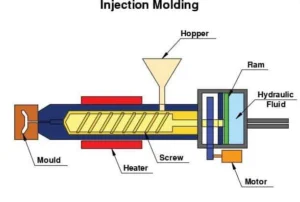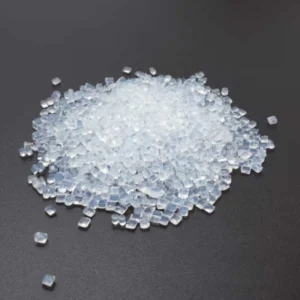
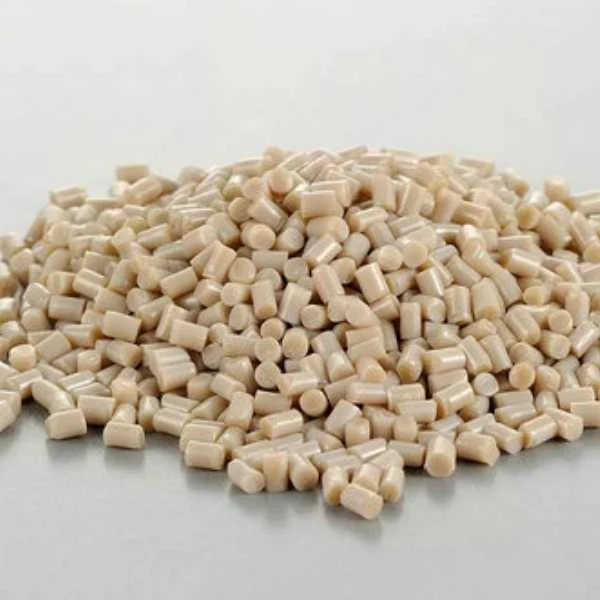
PEEK and PTFE get compared as if the decision were about temperature or chemical resistance. It usually isn’t. The decision that actually costs money is how the part gets made: PEEK melts and flows, so it can be injection molded, extruded, 3D printed or electrostatically sprayed; PTFE never flows, so every PTFE part starts as compressed powder that has to be sintered and then machined. Everything else — strength, creep, friction, cost per part — follows from that one difference.
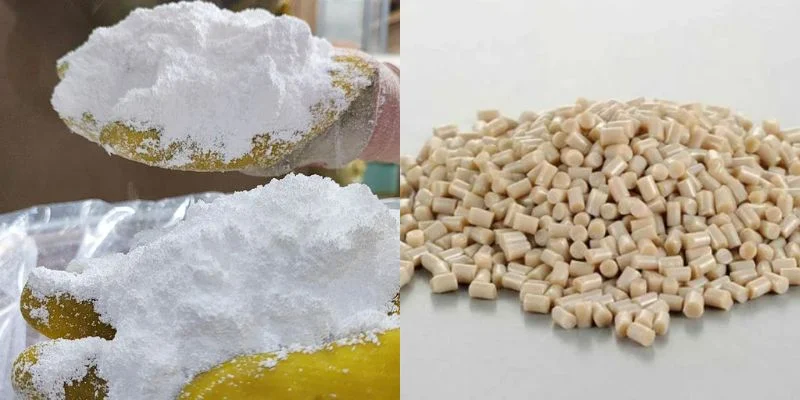
PEEK vs PTFE at a Glance
PEEK is the structural material and PTFE is the chemically inert one; the table below is the short version of what that costs you on each side. The ranges are wider than the single figures published elsewhere because they come from Peflon’s own grade data — 8 series and 92 grades on the PEEK side, separate molding-powder and fine-powder families on the PTFE side — not from a textbook typical value.
| 特性 | PEEK (PF-1 series) | PTFE (PF-S / PF-2 series) |
|---|---|---|
| 溶融加工可能 | Yes — MFR 2.3–80 g/10 min depending on grade | No — no measurable MFR at any temperature |
| Primary processing route | Injection molding, extrusion, compression, 3D printing, electrostatic spray | Cold press + sinter, or paste extrusion with lubricant |
| 引張強度 | 100–110 MPa (unfilled), 145–185 MPa (glass-filled), 205–260 MPa (carbon-filled) | ≥25.5–35 MPa (molding powder) |
| 破断伸度 | 25–45% (unfilled), 1.5–3.3% (filled) | ≥250–400% |
| 曲げ弾性率 | 4.0–4.3 GPa (unfilled) up to 15–23 GPa (carbon-filled) | Low — PTFE is a soft, ductile polymer |
| Heat deflection temperature | 152–156 °C (unfilled), 315–339 °C (glass- or carbon-filled) | Not a meaningful metric — PTFE deforms under load well below its melting point |
| 融点 | ~343 °C | 327 ± 5 °C |
| 連続使用温度 | Limited by load and grade, not by melting point | −200 °C to +260 °C |
| 密度 | 1.30 g/cm³ (unfilled), 1.37–1.52 (filled) | 2.15~2.19 g/cm³ |
| 耐薬品性 | Broad, but attacked by concentrated sulfuric acid and some halogenated media | Near-universal — the known exceptions are molten alkali metals and elemental fluorine |
| Creep / cold flow under sustained load | Resists it — that’s what the HDT and modulus numbers buy you | Cold-flows — the reason PTFE is filled or spring-energized in load-bearing seals |
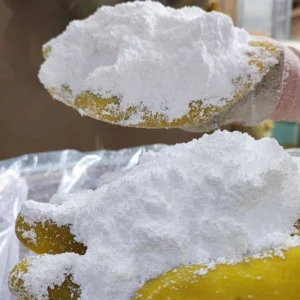
| What you buy it as | Pellets, coarse powder, fine powder (D50 13–99 µm) | Molding powder (15–300 µm), fine powder (D50 450–750 µm agglomerate), dispersion, micropowder |
The Real Divide Is Processing, Not Properties
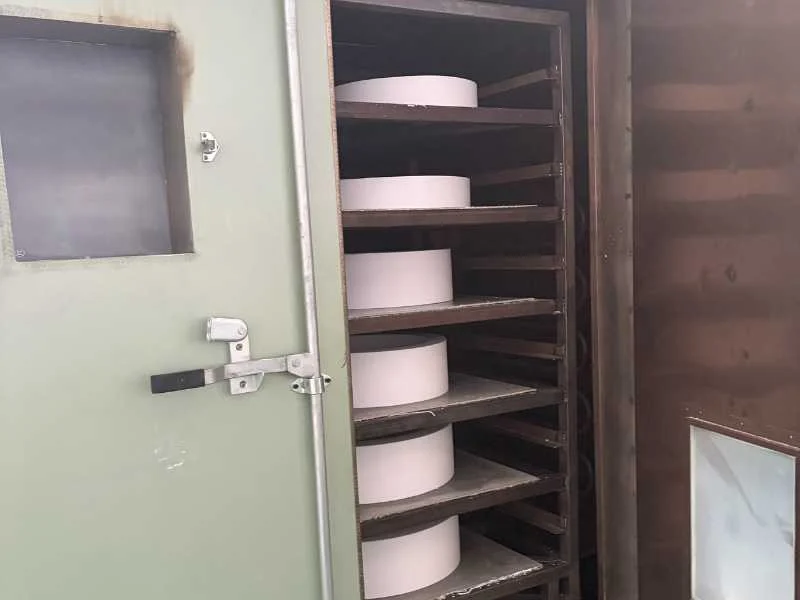
Every PEEK grade on our datasheets carries an MFR value, and no PTFE grade carries one at all. That single missing column tells you more than any property comparison. PF-1CA30-L sits at MFR 2.3 g/10 min, PF-1G-H-TW at 80. On the PTFE side the datasheet field simply doesn’t exist, because PTFE above its 327 °C melting point turns into a gel that will not flow through a gate, a die or a nozzle. That is a property of the polymer itself — ポリテトラフルオロエチレン、CAS 9002-84-0 — not a limitation of any particular supplier’s resin.
What follows from that:
| Question | PEEK | PTFE |
|---|---|---|
| Can it be injection molded? | Yes — near-net-shape parts straight from the tool | なし |
| Can complex geometry be molded in? | Yes — undercuts, thin walls (PF-1G-H-TW is a thin-wall grade), inserts | No — geometry comes from machining a sintered billet |
| How are tubes and profiles made? | 溶融押出 | Paste extrusion of fine powder with a lubricant, then sintering |
| How are large blocks and sheets made? | Compression molding of powder, or machined from extruded stock | Cold pressing followed by a sintering cycle — on thick sections that cycle runs 20–30 days |
| Can it be 3D printed? | Yes — PF-1PF50 (50 µm) is used as printing feedstock; filament needs drying at 120–150 °C | Not by conventional melt-based printing |
| Can it be sprayed as a coating? | Yes — ultra-fine grades PF-1UPF13 to PF-1UPF22 (13–22 µm) for electrostatic spray | Yes, but through a completely different product — aqueous dispersion, not resin |
| Scrap from machining | Low if molded near-net-shape | High — most PTFE parts are cut out of a solid billet |
If your part is a high-volume molded component with features, PEEK’s processing route is the reason to choose it — long before anyone compares tensile numbers. If your part is a gasket, a liner, a machined seal or a sheet, PTFE’s route is normal, mature and cheap, and PEEK’s molding advantage buys you nothing.
What You Actually Buy: Grade-Level Data
Neither material is a single thing. “PEEK vs PTFE” answered at the material level tells you almost nothing about which product code goes on the purchase order.
PEEK: the PF-1 series
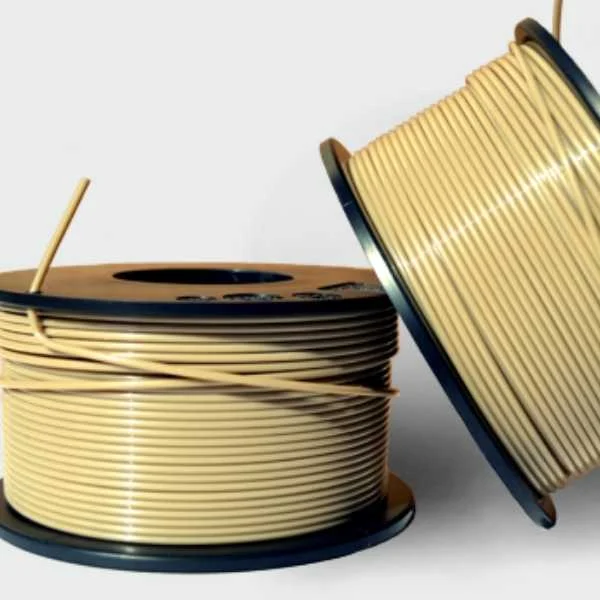
| シリーズ | 引張強度(MPa) | 伸び率(%) | Flexural modulus (GPa) | HDT(℃) | MFR (g/10 min) | 密度(g/cm³) |
|---|---|---|---|---|---|---|
| Pure resin pellets / powders | 100~110 | 25~45歳 | 4.0~4.3 | 152~156 | 10 / 14 / 20 / 80 | 1.30 |
| Glass-fiber reinforced | 145~185 | 2.4~3.3 | 8.5~11.5 | 315~335 | 4.5~40 | 1.43~1.52 |
| Carbon-fiber reinforced | 205~260 | 1.5~2.0 | 15~23 | 325~339 | 2.3–31 | 1.37~1.40 |
| Friction & wear resistant | 140~150 | 2.0~2.2 | 11.5 | 315 | 2.5 / 14 | 1.45 |
The number that decides the grade is usually MFR, not strength. PF-1G-M (MFR 20) is the default for general injection molding; PF-1G-H-TW (MFR 80) exists because thin-wall parts need the melt to fill before it freezes; PF-1CA30-L (MFR 2.3, HDT 336 °C) is deliberately stiff-flowing for extrusion and heavy sections. Pick a high-flow grade for a thick part and you get sink and voids; pick a low-flow grade for a thin-wall part and it won’t fill. Full data on all 92 grades is on the PEEK材料 page, with powder grades broken out separately on PEEKパウダー. The polymer itself is indexed as polyetheretherketone on PubChem.
PTFE: molding powder and fine powder
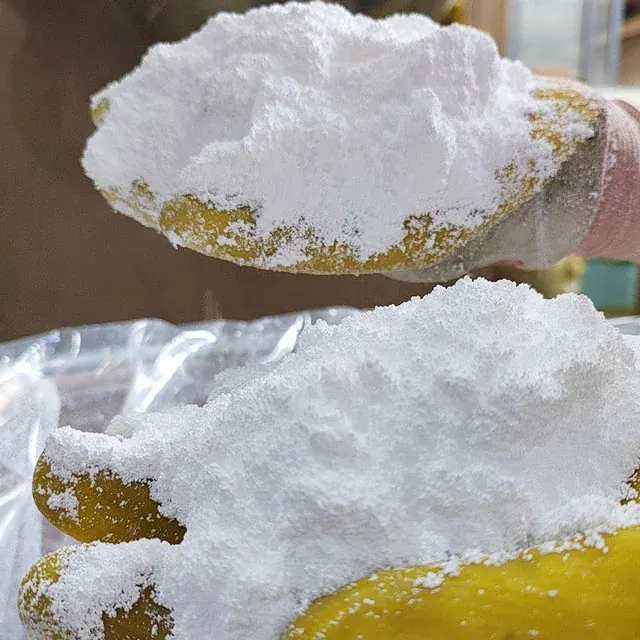
| グレード | 家族 | Particle size | 引張強度(MPa) | 伸び率(%) | Bulk density (g/L) | 代表的な用途 |
|---|---|---|---|---|---|---|
| PF-S06 | 成形用パウダー | 200–250 µm | ≥25.5 | ≥250 | 400–650 | Large molded sheets and rods, linings, wet-process tanks |
| PF-S02 | 成形用パウダー | 150–300 µm | 27歳以上 | ≥250 | 500 ± 100 | Sheets, rods, molded gaskets, bearings |
| PF-S06A | Fine-particle molding | 15–30 µm | ≥30 | ≥300 | 300–450 | Films, pigmented film, electrical insulation parts |
| PF-S08A | Fine-particle molding | 30–40 µm | ≥30 | ≥300 | 300–480 | Large pressed billets, skived film and sheet, semiconductor parts |
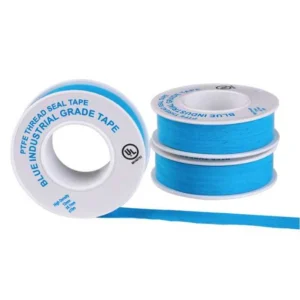
| PF-210 | Fine powder (paste extrusion) | D50 450–750 µm agglomerate | ≥24 (extruded tape) | 300–650 | 475 ± 100 | Thread seal tape, short fiber |
All figures in the two tables above come from Peflon’s PF-1 (PEEK) and PF-S / PF-2 (PTFE) grade datasheets, not from generic material typicals. Confirm the test standard and lot-specific values on the grade TDS before designing to any of these numbers — datasheet ranges cover a family, and your grade sits somewhere inside it.
Note what changes across that table: not the chemistry, which is identical, but the particle size and bulk density — because those determine which forming process the powder is designed for. Buying PF-210 for compression molding, or PF-S06 for paste extrusion, produces a bad part out of a perfectly good resin. Details are on PTFE成形用パウダー と PTFEファインパウダー.
Where Each Material Fails
Both materials have hard limits, and knowing them is more useful than another list of advantages.
PTFE fails on load and dimensional stability. Molding powder grades run ≥25.5–35 MPa tensile against 100–110 MPa for unfilled PEEK and 205–260 MPa for carbon-filled PEEK — a 4× to 10× gap. Worse for design purposes, PTFE cold-flows: hold it under sustained compressive load and it keeps deforming, which is why a PTFE washer under a bolted joint loses preload over months. Filled grades reduce this but bring their own limit — glass-filled PTFE is abrasive and can score the mating surface, and unlike virgin PTFE it is not resistant to hydrofluoric acid or strong alkali, as noted on the modified and filled PTFE page. Virgin PTFE’s only well-known chemical exceptions are molten alkali metals and elemental fluorine.
PEEK fails on chemistry and on process discipline. Concentrated sulfuric acid attacks PEEK — that alone disqualifies it from a large slice of the chemical-processing duty where PTFE is standard. PEEK also has to be dried before processing (150 °C for 3–4 hours before extrusion or injection molding); skip it and you get bubbles, voids and unstable flow, and the part fails for reasons that have nothing to do with the resin. And reinforcement cuts both ways: glass- and carbon-filled PEEK reach 315–339 °C HDT, but elongation at break drops to 1.5–3.3% against 25–45% for unfilled — a filled PEEK part is strong and stiff, and it is also brittle in impact. Background on the polymer family is summarized in the polyetherketone class entry at polymerdatabase.
The honest summary: PTFE is the chemically safer material and the mechanically weaker one, and no grade selection changes that ranking. PEEK is the structural material with a chemical blind spot.
Cost: Price per Kilo Is the Wrong Comparison
PEEK resin costs an order of magnitude more per kilogram than PTFE — the exact multiple moves with grade, filler and volume, so treat any published ratio as a rule of thumb and quote your actual grade. Per finished part the gap is usually smaller than that ratio and sometimes reversed, for four reasons that never appear in a per-kilo quote.
- Density works against PTFE. PTFE is 2.15–2.19 g/cm³; unfilled PEEK is 1.30. The same part geometry needs about 65% more mass in PTFE, so the per-kilo gap narrows before anything else happens.
- Scrap works against PTFE. A machined PTFE part is cut out of a sintered billet, and the swarf is not going back into a virgin-grade process. A molded PEEK part comes out near-net-shape.
- Tooling works against PEEK. Injection molding only beats machining above a volume threshold. Below it, you’re amortizing a mold over too few parts and PTFE’s machine-from-stock route wins outright.
- Lead time is its own cost. Thick PTFE sections need a sintering cycle measured in weeks — 20 to 30 days on heavy billets — because the whole cross-section has to come up and back down through 327 °C without cracking. That’s a scheduling constraint, not a price, and it doesn’t show up in any per-kilo comparison.
The practical rule: for low-volume machined parts, PTFE is cheaper almost regardless of the per-kilo gap. For high-volume molded parts with real geometry, run the numbers per part — the answer flips more often than people expect.
You Don’t Always Have to Choose: PTFE-Filled PEEK
PTFE’s low friction can be added to PEEK’s load capacity. Peflon’s friction-and-wear series does exactly this — PTFE, carbon and graphite tribological compounds in a PEEK matrix, sold as standard grades rather than custom blends:
- PF-1FC30-L (MFR 2.5, HDT 315 °C) — low friction, self-lubricating, automotive-grade, for extrusion and heavy sections
- PF-1FC30-H (MFR 14, HDT 315 °C) — the same tribology in an injection-molding flow grade
- PF-1FE20-H — lubrication-modified for sealing parts and food-machinery wear components
- PF-1FC327 — for steel-backed bearings, oil-free running under heavy load and high torque
These land where neither pure material works: a bushing that has to run dry (PTFE’s job) while carrying real load at 200 °C+ without creeping (PEEK’s job). The tradeoff is that you get neither material’s extreme — the friction is higher than pure PTFE, and the chemical resistance is PEEK’s, not PTFE’s. Grade details sit in the friction-and-wear series on the PEEK材料 page, and finished-part capability on PEEK CNC machined parts.
Choosing, in Four Questions
- Does the part carry sustained mechanical load? If yes, PTFE needs filling or spring energizing at minimum, and PEEK is probably the right answer. If no, PTFE’s weakness stops mattering.
- What exactly does it touch? Concentrated sulfuric acid, or an unknown mixed chemical stream, points to PTFE. Fuels, steam, hydraulic fluid and general industrial media are fine for PEEK.
- How is the part going to be made, and how many? Molded geometry at volume favors PEEK. Machined from stock, or one-offs, favors PTFE.
- Which form of the material do you actually need? Pellets, powder, fine powder or dispersion — this is where most sourcing mistakes happen, and it’s grade-level, not material-level. A 50 µm PEEK powder and a 50 µm PTFE powder are bought for completely different processes.
What Peflon Supplies
Peflon manufactures both families, so this isn’t a question of which material we’d rather sell.
- PEEK: 92 grades across 8 series — pellets, coarse and fine powders (D50 13–99 µm), glass- and carbon-fiber reinforced, friction-and-wear, ceramic-modified, ESD and implant-grade. See PEEK材料 と PEEKパウダー.
- PTFE: molding powder, fine powder for paste extrusion, aqueous dispersion, micropowder and filled compounds. See PTFE成形用パウダー, PTFEファインパウダー, PTFEディスパージョン と modified and filled PTFE.
Send the part, the load, the temperature and the medium it contacts, and we’ll come back with a specific grade code — or tell you that the other material is the better fit.
よくあるご質問
Is PEEK the same as Teflon?
No. Teflon is a brand name for PTFE and related fluoropolymers; PEEK is polyetheretherketone, a completely different polymer family. The practical difference is that PEEK melts and flows so it can be molded, while PTFE does not flow at any temperature and has to be sintered.
Is PEEK stronger than PTFE?
Yes, substantially. Unfilled PEEK runs 100–110 MPa tensile and carbon-filled grades reach 205–260 MPa, against ≥25.5–35 MPa for PTFE molding powder. PEEK also resists creep under sustained load, where PTFE cold-flows.
Does PEEK have better chemical resistance than PTFE?
No. PTFE is the more chemically inert of the two — its only well-known exceptions are molten alkali metals and elemental fluorine. PEEK handles a broad range of media but is attacked by concentrated sulfuric acid, which rules it out of duty where PTFE is routine.
Which handles higher temperature, PEEK or PTFE?
It depends on whether the part is loaded. PTFE is rated for continuous service from −200 °C to +260 °C but deforms under load well below that. Filled PEEK grades hold 315–339 °C heat deflection temperature, so under mechanical load PEEK holds shape at temperatures where PTFE would not.
Why is PEEK so much more expensive than PTFE?
Per kilogram PEEK is an order of magnitude more expensive, driven by monomer cost and polymerization complexity. Per finished part the gap is smaller than it looks: PTFE is 65% denser, so the same geometry uses more mass, and PTFE parts are usually machined from billet with high scrap, while PEEK can be molded near-net-shape. Ask for a quote on the specific grade and volume rather than working from a published ratio.
Can PEEK and PTFE be combined?
Yes. PTFE-filled PEEK compounds — the PF-1FC and PF-1FE series — put PTFE’s low friction into a PEEK matrix for bearings, seals and dry-running sliding parts. They give up some of PTFE’s slipperiness and all of PTFE’s chemical inertness in exchange for load capacity.
Which form should I order — pellets, powder or dispersion?
It depends on the forming process, not on the material. PEEK ships as pellets for injection and extrusion, coarse powder for modification, and 13–99 µm fine powders for compression molding, 3D printing and electrostatic spray. PTFE ships as 15–300 µm molding powder for cold press and sinter, fine powder for paste extrusion, and aqueous dispersion for coating and impregnation.