An engineer opens a glass-fiber PEEK datasheet, sees an HDT of 315°C, and signs off a part for 250°C continuous service. The line runs. Six months later, that part has crept out of tolerance, a seal has lost preload, and a customer is asking why. I have watched this exact mistake cost a downstream manufacturer a full production batch. The number was real. The reading was wrong. The fix is knowing which of PEEK’s four temperature numbers actually governs your part — and reading them in the right order.
Why HDT Is the Number That Fools Most Buyers
Heat deflection temperature (HDT) is a short-term test, not a service rating, so it almost always overstates how hot you can run a part. It measures the temperature at which a standard bar bends a fixed amount under a set load, usually 1.8 MPa, per ISO 75 / ASTM D648. Think of it as a quick pass-or-fail screen, not a lifetime promise.
Here is where it gets dangerous. Add 30% glass or carbon fiber to PEEK and the HDT can jump from roughly 152°C to over 300°C. The fiber network holds the bar straight while the polymer around it has already softened.
That high number says nothing about ten years of duty. Under steady load and heat, the softened matrix keeps deforming slowly — a process called creep. The fibers slow it; they do not stop it.
So a part can pass every bench test, then fail in the field by creeping, relaxing, or losing dimensional accuracy long after the HDT figure suggested it was safe. I keep one rule for my OEM accounts: treat HDT as a sorting tool, never as the spec.
The Four Numbers That Actually Define PEEK’s Heat Limits
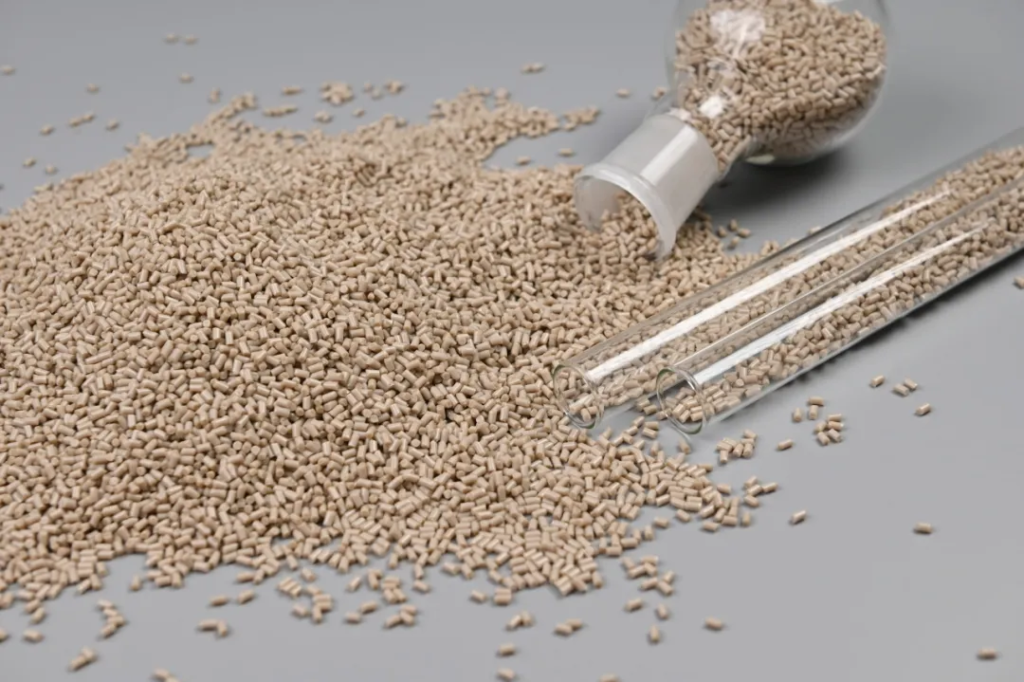
PEEK gives you four thermal figures, and each answers a different question. Confuse them and you either over-pay or under-build.
- Glass transition temperature (Tg ~143°C): the point where the non-crystalline regions of the polymer shift from rigid to soft. Measured by DSC per ISO 11357. It is a transition, not a cliff.
- Melting point (Tm ~343°C): where the crystal structure collapses. This is both your processing floor and the absolute ceiling no part survives.
- HDT (~152–160°C unfilled, ~300–315°C reinforced): short-term stiffness under load. A screening value only.
- Continuous service / RTI (~240–260°C): the long-haul number. This is the one your part lives or dies by.
Independent, peer-reviewed work confirms the base figures: PEEK shows a Tg near 143°C and a Tm near 343°C. Those are physics, not marketing.
The number most engineers underuse is the last one. Continuous service temperature describes how hot a material can run for thousands of hours without losing key properties. PEEK’s sits around 260°C in unloaded or lightly loaded use.
When that figure is backed by a UL 746B Relative Thermal Index, it is even stronger. RTI is set by aging samples until a property drops to half its starting value, extrapolated to 100,000 hours — roughly 11 years of service.
If HDT is a sprint, RTI is the marathon, and you spec parts for the marathon.
Can You Run PEEK Above Its Tg? Yes — Here’s Why
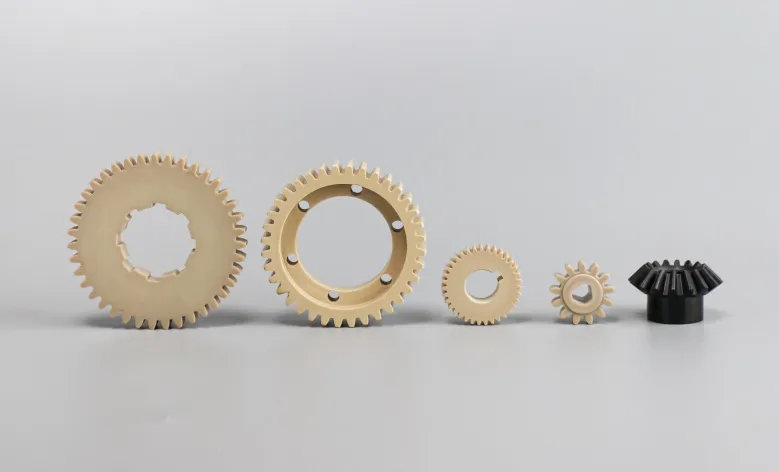
You can run PEEK well above its 143°C Tg, because PEEK is semi-crystalline: its crystalline regions keep carrying load after the amorphous regions soften. This is the question I field most from new buyers — “my application is hotter than Tg, so PEEK is out, right?” Almost always, no.
Picture two phases sharing the same part. Below Tg, both are stiff. Above Tg, the amorphous phase turns rubbery and flexible, while the crystalline phase holds its shape and bears the stress.
Independent studies confirm PEEK runs to a continuous use temperature of 260°C despite that 143°C Tg. The crossing of Tg is not failure; it is a shift in the balance between stiffness and toughness.
That said, the trade-off is real. Above Tg, unfilled PEEK loses rigidity. If your part carries meaningful load above ~143°C, you move to a reinforced grade to restore stiffness — not because PEEK “fails” at Tg, but because the design now needs the fiber.
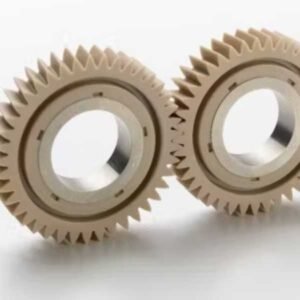
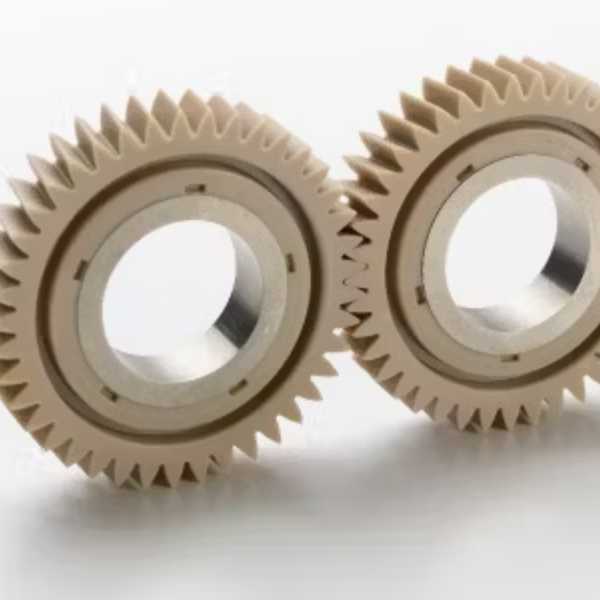
I learned this on a pump gear that a customer feared would slump at 180°C. Unfilled, it held form but flexed more than the gear mesh liked. Switching to a glass-fiber grade fixed the deflection without changing the chemistry. The Tg never moved. The design intent did.
Unfilled vs GF30 vs CF30: Pick the Grade by the Load, Not the Brochure
Most grade choices come down to three families: unfilled, 30% glass fiber (GF30), and 30% carbon fiber (CF30). The brochure pushes the biggest number. The load tells you the right one.
Parameter Matrix (Typical Industry Values)
| Property (test method) | Unfilled PEEK | PEEK GF30 | PEEK CF30 |
|---|---|---|---|
| Glass transition Tg (ISO 11357) | ~143°C | ~143°C | ~143°C |
| Melting point Tm | ~343°C | ~343°C | ~343°C |
| HDT at 1.8 MPa (ISO 75 / D648) | ~152–160°C | ~300–315°C | ~310–315°C |
| Continuous service / RTI | ~240–260°C | ~250–260°C | ~250–260°C |
| Tensile modulus | ~3.5–4 GPa | ~11 GPa | ~22–24 GPa |
| Thermal conductivity | ~0.29 W/m·K | ~0.43 W/m·K | ~0.9 W/m·K |
| Linear expansion (CLTE) | highest | lower | lowest (directional) |
| Electrical behavior | insulator | insulator (~10¹⁴ Ω·cm) | conductive (~10⁴ Ω·cm) |
| Densité | ~1.30 g/cm³ | ~1.51 g/cm³ | ~1.38–1.40 g/cm³ |
| Relative cost index | 1.0 | ~1.1–1.3 | ~1.5–2.0 |
Values are typical cross-supplier ranges for selection only — confirm against your supplier’s COA before you spec.
When GF30 Wins
Glass fiber raises stiffness about threefold over unfilled PEEK and improves creep resistance under sustained load, while staying a full electrical insulator.
- Pump housings, valve bodies, structural brackets above 150°C.
- Parts that need both rigidity and dielectric isolation.
- Budgets where carbon fiber’s premium is hard to justify.
When CF30 Wins
Carbon fiber pushes modulus to roughly twice that of GF30 and triples thermal conductivity, pulling heat away from contact surfaces.
- Bearings, bushings, and wear parts where stiffness and lubricity matter.
- Components fighting heat build-up at sliding interfaces.
- Weight-critical brackets replacing aluminum.
The Costs Nobody Prints
Two penalties rarely appear in the headline specs:
- Carbon fiber is conductive. Near aluminum or magnesium in a humid environment, CF30 can drive galvanic corrosion. Isolate it.
- Reinforced grades chew tooling. Glass fiber can cut tool life 50–70% versus unfilled; carbon fiber adds directional shrinkage and tighter machining control.
A Four-Step Protocol to Specify PEEK Without Guessing
I give every new distributor partner the same sequence. Run the numbers in this order and the wrong grade rarely survives the screen.
| Étape | Number to check | Question it answers | Cost of skipping it |
|---|---|---|---|
| 1 | RTI / Continuous service | Will it survive years at peak temp? | Slow field failure by aging |
| 2 | HDT | Does it hold shape under short-term heat + load? | Deflection during assembly or spikes |
| 3 | Tg | Do I need fiber to keep stiffness? | Soft, flexing part above 143°C |
| 4 | Tm | Can my equipment process it? | Unmoldable or scorched material |
- Start at RTI, not HDT. Set the part’s true continuous temperature, then demand a grade rated above it. This is your safety floor.
- Use HDT only to screen short-term spikes. It confirms the part won’t sag during a brief overshoot or a hot assembly step.
- Check Tg against load. If service runs near or above 143°C with real stress, specify a reinforced grade to offset matrix softening.
- Confirm Tm against your line. PEEK melt processing sits around 360–400°C; verify the machine and tooling can hold it.
What This Really Costs: A TCO View for Buyers and Distributors
On a high-temperature part, the resin price is the smallest number in the equation — the cost of a wrong spec dwarfs it. Procurement teams often optimize the per-kilogram line and ignore the rest of the total cost of ownership (TCO): scrap, rework, downtime, and the qualification you have to run twice.
Here is an illustrative breakdown for a single PEEK component, with figures shown only to compare magnitudes:
| Cost element | Under-spec (cheaper grade) | Right-spec (correct grade) |
|---|---|---|
| Resin / blank cost | Lowest | +10–40% |
| Machining & tooling | Standard | Standard to +20% |
| Field failure & downtime | High and likely | Proche de zéro |
| Re-qualification | Often required | Avoided |
| Total cost of ownership | Highest | Lowest |
The pattern repeats across my accounts: the grade that looked expensive at quote was the cheapest by the time the part had run a year. Spend on the grade, save on the failure.
The Distributor Angle
For resellers, accurate specification is margin protection, not a courtesy. Every grade you quote wrong comes back as a return, a replacement, or a lost account.
- A distributor who specs by the four-step protocol cuts return rates and defends gross margin.
- Pointing a customer from CF30 down to GF30 — when the load allows — builds the trust that wins the next three orders.
- Carrying the right grade in stock beats carrying the most expensive one nobody buys twice.
Sourcing PEEK: Documentation, MOQ, Lead Time, and Customs
A correct grade still fails the buyer if the paperwork and logistics do not hold up. This is where international B2B deals quietly break.
- Documentation. Insist on a Certificate of Analysis (COA) with batch traceability. For regulated end-uses, ask for the specific clearance — NORSOK M-710 certified grades for sour gas and steam, or aerospace flammability data — rather than a generic claim.
- MOQ and lead time. Resin pellets, rod, and plate carry different minimum order quantities and lead times. Plan for melt-processing lead time on custom shapes, and confirm whether stock sits in a regional warehouse or ships from origin.
- Customs and shipping. Confirm the correct HS code with your forwarder, account for ocean versus air lead time, and check that test certificates travel with the goods to clear inspection without delay.
Match the grade’s thermal and chemical profile to the application first, then lock the documentation and logistics second. Skip either and the order stalls at the dock.
Quick Answers to the Questions Buyers Ask Most
Can PEEK be used above its Tg of 143°C?
Yes. The crystalline phase carries load past Tg. For loaded parts above 143°C, move to a reinforced grade.
What is the continuous service temperature of PEEK?
Around 240–260°C for long-term use, with short spikes tolerated higher depending on load and grade.
HDT vs continuous service temperature — what’s the difference?
HDT is a short-term stiffness screen. Continuous service / RTI is the long-term aging limit. Spec to the second.
GF30 or CF30 — which do I choose?
GF30 for stiffness plus electrical insulation at lower cost. CF30 for maximum stiffness, wear resistance, and heat dissipation, where conductivity is acceptable.
What is the maximum temperature PEEK can handle?
It melts near 343°C, which is the absolute ceiling. Useful service tops out far below that, governed by RTI.
The Reading That Keeps Parts in Tolerance
Four numbers, four jobs. Tg tells you when stiffness shifts, HDT screens short-term heat, Tm sets the processing and failure ceiling, and RTI tells you how long the part will actually last. The buyers who get burned read one number — usually HDT — and stop. The buyers who ship reliable parts read all four, in order, and tie the grade to the real duty cycle. Specification is a sequence, not a single figure.
Talk to Someone Who Reads the Whole Datasheet
I am a key account manager at Peflon, and I would rather talk you out of an over-spec than sell you the wrong grade twice. Send us your part’s continuous temperature, load, and environment, and we will match it to the right Peflon PEEK resin grade — or tell you when PEEK is overkill versus PTFE for the job. Request a PEEK sample with full COA and we will include the thermal data that maps to your duty cycle, not just the number that looks best on paper.